Karachi
0346 4111188

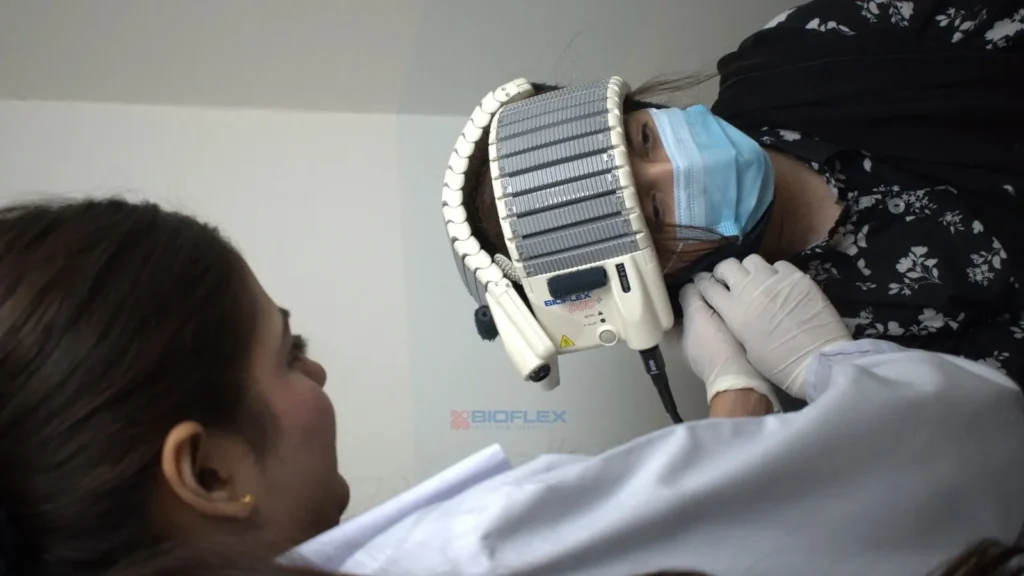
If you’ve been reading about laser therapy, sometimes called cold laser therapy or LLLT, or you’ve already had a session and you’re wondering whether it’s doing anything, you’ve probably run into two very different kinds of answers online. One side treats it as a near-miracle cure for everything from joint pain to Alzheimer’s. The other dismisses it as pseudoscience. Neither is quite right.
The honest answer is: it depends on what you’re treating. Laser therapy (the clinical terms are low-level laser therapy, LLLT, or photobiomodulation) has real clinical trial evidence behind it for some conditions and very little for others. This article goes through what researchers have actually studied, so you can judge for yourself whether it makes sense for your situation.
Laser therapy for pain uses low-power laser light, usually in the red or near-infrared range, between about 600 and 1000 nanometers, to deliver light energy into tissue without generating heat. That’s why it’s also called “cold laser” therapy: unlike a surgical or cosmetic laser, it isn’t cutting or burning anything.
The idea, supported by a fair amount of lab research, is that mitochondria in cells absorb this light and set off a cascade of effects: more cellular energy production, reduced inflammatory signaling, and in some tissues, better blood flow and faster repair. Depending on their power output, these devices go by several names: cold lasers, low-level lasers, LLLT units, or Class 3B/Class IV laser systems.
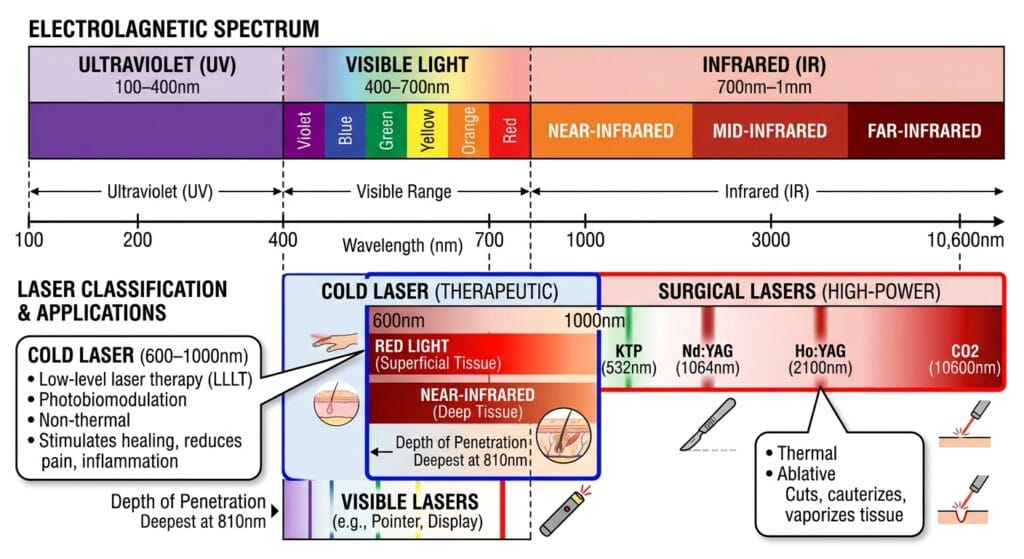
In the US, the FDA clears laser devices used for this purpose for adjunctive treatment of musculoskeletal pain, meaning manufacturers can market and sell them for that use. That’s a different thing from being “FDA-approved” to cure a specific disease, and the distinction matters. We’ll come back to it.
Rather than a blanket yes or no, here’s how the evidence actually breaks down, condition by condition, based on real randomized controlled trials.
Shoulder tendinopathy has some of the best-supported evidence of any condition treated with LLLT. A 2015 review pooling 17 randomized trials found meaningful pain relief compared with placebo, whether patients used the laser alone or alongside exercise therapy. The effect held up even in the highest-quality trials.
Tennis elbow (lateral epicondylitis) has similar backing. A review of 13 trials and 730 patients found a real pain-relief effect over placebo, and the effect was notably stronger in studies that applied the laser directly over the tendon using specific wavelengths. That detail matters: LLLT’s effectiveness depends heavily on the wavelength, dose, and treatment site, so not every laser protocol will perform the same.
Neck pain has arguably the strongest single piece of evidence in the entire field: a Lancet review pooling 16 trials and 820 patients found a significant reduction in pain for acute neck pain, with effects still measurable up to 22 weeks later for chronic cases.
This is a less-talked-about strength of LLLT, but the data is genuinely favorable. A 2021 review of 13 trials in diabetic foot ulcer patients found laser therapy roughly doubled the rate of complete wound healing compared with standard care. A larger 2025 review found an even bigger effect for early-stage ulcers. Both reviews note that strict grading standards still rank the certainty of evidence as low (more, larger trials would help), but the direction and consistency of the results are encouraging for a condition that’s often slow and frustrating to treat.
For knee osteoarthritis, laser therapy mainly helps as an add-on to exercise-based rehabilitation rather than on its own. The World Association for PhotobioModulation Therapy (WALT) publishes specific dosing guidelines for different conditions, and studies that stick closer to those doses tend to show better results. That’s part of why some laser studies come back negative: they simply used too little energy.
Frozen shoulder has moderate support too. A recent analysis of 8 trials and 444 patients found meaningful improvement in both pain and shoulder mobility when patients used it as part of a broader treatment plan.
Low back pain is where you’ll want to keep your expectations realistic. A Cochrane review (Cochrane reviews are generally considered the gold standard for summarizing medical evidence) found “some evidence” of short-term pain relief but concluded there wasn’t enough good-quality data to say definitively how well it works. It’s a reasonable option to try alongside standard back care, not a guaranteed fix.
Here the research genuinely disagrees with itself. Some trials on carpal tunnel syndrome show improvement in grip strength and pain; a larger pooled analysis of 8 trials and 473 patients found no significant benefit over placebo. If you have carpal tunnel syndrome, splinting is still considered the first-line conservative treatment, and you can think of laser therapy as a possible add-on to that.
We want to be upfront here: for migraine and primary headache, a 2022 systematic review of the available trials rated the evidence as low quality and concluded there wasn’t enough to support using photobiomodulation as a headache treatment. For conditions like Parkinson’s disease, Alzheimer’s, depression, and epilepsy, the research on delivering laser light to the brain (transcranial photobiomodulation) exists only as small pilot studies. That’s interesting as early-stage science, but nowhere near strong enough to call it an established treatment. If you see a clinic promising laser therapy will treat these conditions, that claim is running well ahead of the evidence.
One thing is consistent across nearly every study we looked at, regardless of condition: laser therapy has a strong safety record. Serious side effects are rare across the research, which is worth knowing even where the pain-relief evidence itself is thin.
Across the studies covering all the conditions above, the research commonly reports no serious adverse events. Some patients notice mild, temporary warmth or tingling at the treatment site during a session. It’s a non-invasive, drug-free option, which is part of why clinicians often use it alongside physiotherapy, medication, or other standard care, rather than instead of them.
This varies a lot by condition, and by how researchers designed the specific study protocols. WALT’s published dosing guidance for tendon and joint conditions generally points toward daily sessions for around two weeks, or sessions every other day over three to four weeks, with each session lasting anywhere from a few minutes to around twenty. Wound healing protocols tend to run longer, since they’re tracking a biological repair process rather than pain relief. Your actual number of sessions will depend on your specific condition, how long you’ve had it, and how you respond, which is exactly the kind of thing to discuss during a consultation rather than assume from a generic number online.
Laser therapy isn’t a cure-all, and it isn’t nonsense either. For shoulder and neck pain, tennis elbow, and wound healing, there’s solid trial evidence behind it. For knee osteoarthritis, frozen shoulder, and back pain, it’s a reasonable adjunct to standard treatment, most useful alongside exercise or physiotherapy rather than by itself. For neurological conditions, the evidence is still too thin, and any clinic telling you otherwise is overselling it.
At BioFlex Pakistan, we treat laser therapy as one part of a broader treatment plan, and we’ll tell you plainly if your specific condition is one where the evidence is strong or one where it’s still early. If you’d like to talk through whether it’s a fit for what you’re dealing with, you can book a consultation at our Islamabad, Karachi, or Peshawar clinic.
For several specific conditions, particularly shoulder tendinopathy, tennis elbow, and neck pain, multiple clinical trials show it reduces pain more than placebo. For other conditions the evidence is weaker or mixed, so it depends on what you’re treating.
No. Laser therapy for pain relief (what people sometimes call cold laser therapy) uses low-power light that doesn’t generate heat or cut tissue, unlike surgical or some cosmetic lasers. It’s a non-invasive, painless treatment.
It depends on which condition you’re treating. Published protocols range from about ten sessions over two weeks for acute pain to longer courses for wound healing. Your clinician can give you a specific plan after an assessment.
Across the published research, serious side effects are rare. Some people notice mild warmth or tingling during treatment, but researchers generally regard it as a safe, non-invasive option.
Laser devices used for this purpose have FDA clearance for adjunctive treatment of musculoskeletal pain in the US. That’s a regulatory clearance to market the device for that use, not an approval claiming it cures a specific disease.
Not established yet. The research here only covers small, early-stage pilot studies. It’s an area worth watching, but strong clinical evidence doesn’t back it yet, and you should be cautious of any provider claiming otherwise.
Written by: Bioflex Pakistan Editorial Team
Reviewed by: Dr. Maria Ahmed
Credentials: MBBS, Dermatologist/Aesthetic Physician
PMDC Registration: 625405
Last Medically Reviewed: October 2026
Last Updated: August 2026