Karachi
0346 4111188

Written by: BioFlex Pakistan Editorial Team
Reviewed by: Dr. Maria Ahmed
Credentials: MBBS, Dermatologist/Aesthetic Physician
PMDC Registration: 625405
Medically Reviewed: October 2026
Most patients need somewhere between 6 and 20 low-level laser therapy (LLLT) sessions to notice a meaningful change in pain, usually scheduled two to three times a week over two to six weeks. The exact number depends on how long you’ve had the problem, how severe it is, and which condition is being treated. A physiotherapist or laser therapy provider can only give you a precise number after a physical assessment.
If you’ve already read our article on whether laser therapy actually works, this is the natural next question: assuming it does help, how many visits will it actually take? Here’s what the research and clinical practice say, and how laser therapy at BioFlex Pakistan is typically scheduled.
Laser therapy isn’t a one-size-fits-all prescription. Physiotherapists and pain clinics adjust session count and frequency based on several factors. Acute pain, like a recent ankle sprain or muscle strain, often responds faster than pain that has been present for months or years, since chronic conditions involve tissue changes such as inflammation, reduced blood flow, and scar tissue that take longer to reverse. The specific condition matters too: soft-tissue injuries and inflammatory joint conditions like osteoarthritis are usually treated on different schedules than nerve-related pain or post-surgical recovery, and more advanced or longstanding cases generally need more cumulative sessions than mild, early-stage ones.
Your body’s own response also shapes the plan. Some patients notice pain reduction within the first two or three sessions; others need to complete most of the course before seeing a clear change, because laser therapy’s effects build up cumulatively rather than all at once. And because laser therapy is often used alongside physiotherapy or exercise, that combination can change how many sessions get scheduled as well.
The ranges below reflect patterns commonly seen in clinical research and physiotherapy practice. They’re a starting point for what to expect, not a guarantee of your own results or a substitute for an in-person assessment.
| Condition | Typical course | Usual frequency |
| Acute soft-tissue injury or sprain | 6 to 10 sessions | 2 to 3x per week |
| Chronic low back pain | 10 to 20 sessions | 2 to 3x per week |
| Knee osteoarthritis | 8 to 15 sessions | 2 to 5x per week |
| Frozen shoulder | 10 to 18 sessions | 2 to 3x per week |
| Plantar fasciitis | 8 to 12 sessions | 2 to 3x per week |
| Sports injuries (recovery phase) | 6 to 12 sessions | 2 to 3x per week |
A Cochrane systematic review of laser therapy for chronic low back pain found that the number of sessions used across clinical trials varied considerably, and that treatment protocols were not consistent from one study to the next. That’s part of why your provider tailors your plan rather than applying a fixed number to everyone.
Most laser therapy plans follow a similar overall pattern, even though the exact numbers differ by condition. It starts with an initial assessment, where your provider examines the affected area, reviews your history, and identifies the specific tissue or joint involved before recommending a session plan. That’s usually followed by an initial block of treatment, often the most frequent phase, typically two to three sessions per week for the first two to four weeks, since consistent dosing early on tends to produce better results than spaced-out, occasional visits.
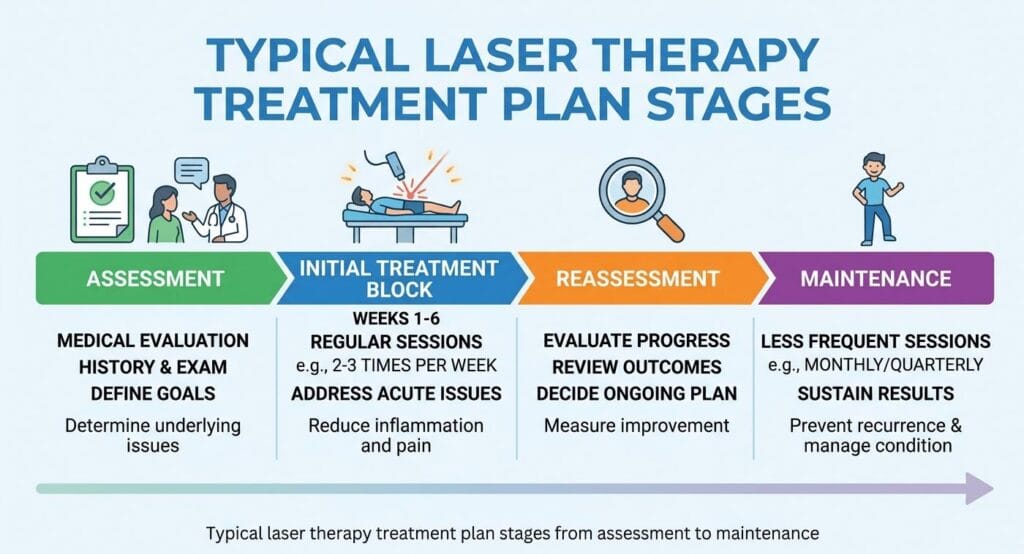
After that block, your provider reassesses you. Pain levels, range of motion, and function are usually reviewed to decide whether to continue, taper, or conclude treatment. For chronic conditions, some patients move to less frequent maintenance sessions once the initial improvement is achieved, rather than stopping abruptly.
Each individual session is short, typically a few minutes per treated area, so the time commitment is less about any single visit and more about attending consistently for the full course.
This is a related but separate question from how many sessions you’ll need in total; we cover it in more depth in how long laser therapy takes to work. In short, some patients report mild improvement after just a few sessions, while others, especially with chronic or longstanding pain, may need to complete most or all of the recommended course before the benefit becomes clear. Laser therapy is generally not a one-visit fix, and expecting dramatic relief from a single session can lead to disappointment even when the treatment is working as intended.
There isn’t strong evidence that laser therapy carries cumulative risk the way some other treatments do, but that doesn’t mean more is automatically better. If you’re not seeing any change after completing a full recommended course, that’s useful clinical information. It may mean the treatment isn’t the right fit for your specific condition, or that an underlying issue needs further evaluation. A good provider will reassess rather than simply extending treatment indefinitely.
Because this is one of the most common questions patients ask before starting, it’s worth being upfront: nobody can tell you your exact number of sessions from a blog article. What we can tell you is what your assessment will look for, including how long you’ve had the pain, whether it’s acute or chronic, the specific joint, muscle, or tissue involved, any other treatments you’re currently using, and how you respond after the first few sessions.
At BioFlex Pakistan’s clinics in Islamabad, Karachi, and Peshawar, your treatment plan is built around your specific assessment rather than a fixed package, since two patients with “back pain” can need very different courses of care depending on the underlying cause.
FAQ Section
Most patients complete 6 to 20 sessions, typically scheduled two to three times a week over two to six weeks. Your provider will give you a specific number after assessing your condition.
Two to three sessions per week is the most common frequency during the initial treatment phase, since laser therapy’s effects build up with consistent, closely spaced sessions.
Some patients notice mild, temporary improvement after a single session, but laser therapy is generally a cumulative treatment. Meaningful, lasting relief usually requires completing the full recommended course.
Generally, yes. Chronic or longstanding pain typically needs a longer course than a recent, acute injury, since the underlying tissue changes take more time to address.
Your provider will reassess your pain and function. Depending on your progress, you may conclude treatment, move to occasional maintenance sessions, or discuss other options if the expected improvement hasn’t occurred.
If you’re dealing with ongoing pain and want a session plan built around your specific condition rather than a generic package, book a consultation at BioFlex Pakistan’s Islamabad, Karachi, or Peshawar clinic. A physiotherapist can assess your condition and outline realistic expectations for how many sessions you’re likely to need.