Karachi
0346 4111188

Written by: BioFlex Pakistan Editorial Team
Reviewed by: Dr. Maria Ahmed, MBBS, Consultant Dermatologist
10 years of clinical experience, providing low-level laser therapy for pain at BioFlex Pakistan
PMDC Registration: 625405
Medically Reviewed: October 2026
If you’ve been living with joint pain, back pain, or a sports injury that just won’t heal, you’ve probably already tried the usual route: painkillers, physiotherapy, maybe a cortisone injection. Low-level laser therapy (LLLT) works differently. And it’s getting easier to find in Pakistan. Clinics are now open in Islamabad, Karachi and Peshawar, and patients from Rawalpindi can reach them without much trouble.
This guide walks through what LLLT actually is, what the research supports, which conditions it treats, and what to expect if you book a session in Pakistan.
Low-level laser therapy, also called cold laser therapy or photobiomodulation therapy (PBMT), uses light at specific wavelengths to stimulate cells in damaged or inflamed tissue. Unlike surgical lasers, which cut or burn tissue, LLLT devices produce light at an intensity too low to generate heat. No cutting, no burning sensation, no recovery downtime.
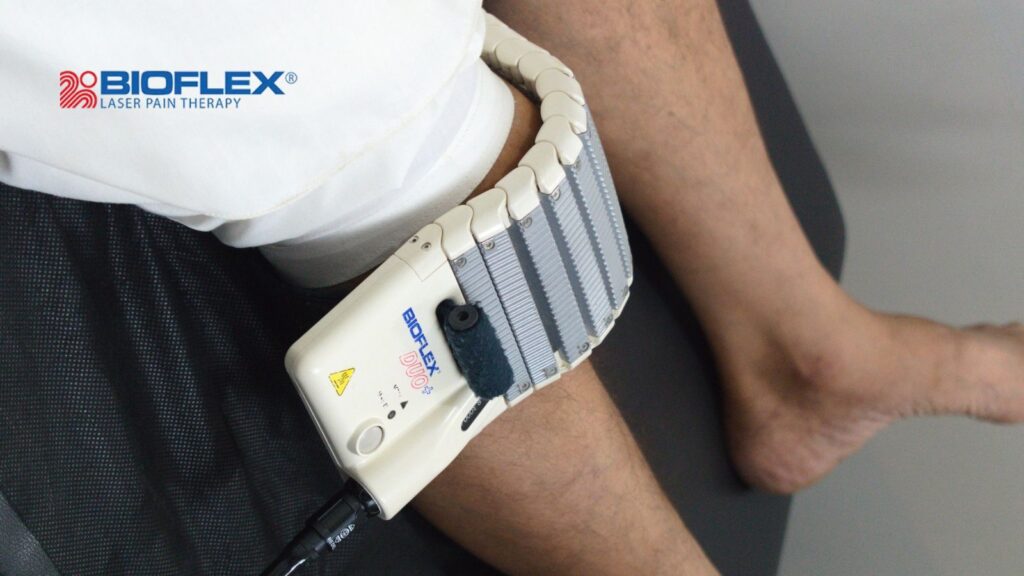
That’s also where the “cold laser” nickname comes from: patients don’t feel any heat during treatment. A typical session involves placing a laser array or handheld probe over the affected area for several minutes while red and infrared light penetrate the skin.
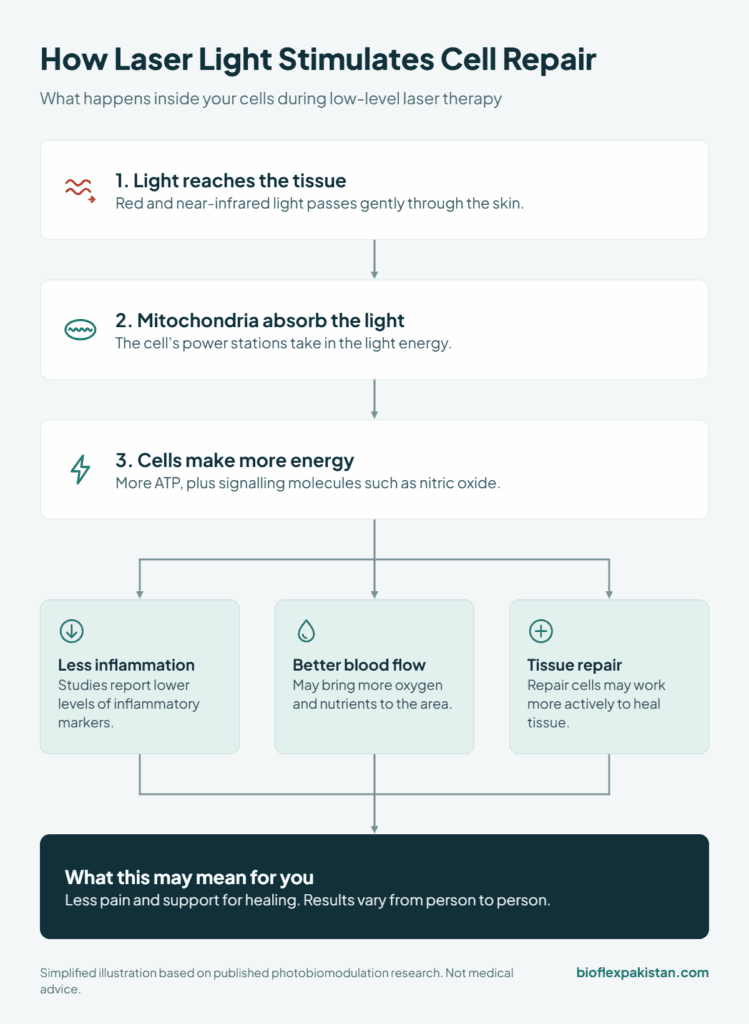
LLLT works through a process called photobiomodulation. The red and near-infrared light energy gets absorbed by mitochondria, the energy-producing structures inside cells, and that boosts production of ATP, the molecule cells use for energy. Researchers have been studying the downstream effects of this for decades, and a few keep showing up consistently:
Worth being precise here: LLLT isn’t one single, uniform effect. The outcome depends heavily on wavelength, dose, and how many sessions are used, and that’s a big part of why a good treatment plan is personalized rather than off the shelf.
This is the question serious patients should ask before committing to any treatment. The honest answer is: it depends on the condition.
The evidence is strongest for musculoskeletal and soft-tissue conditions:
Here’s the honest summary. LLLT has real, mechanistically explained effects on inflammation and pain signaling, and several randomized trials support benefit for specific conditions like chronic low back pain and soft-tissue injury. It isn’t a guaranteed cure. Results vary by condition and by how the therapy is dosed, and it works best as part of a supervised, condition-specific protocol rather than a generic one-size-fits-all treatment. Any clinic offering LLLT should be able to tell you exactly what protocol they use and why.
For a closer look at the individual studies and what they mean for different types of pain, read our full breakdown: does laser therapy work for pain relief?
LLLT is generally considered a low-risk, non-invasive procedure. Because the light energy used sits well below the threshold that damages tissue, there’s no cutting, no anesthesia, and typically no downtime between sessions. The main precaution during treatment is eye protection, since both patient and therapist wear protective glasses while the laser probe is in use.
That said, “safe” doesn’t mean “appropriate for everyone.” LLLT is generally not recommended over active cancer sites, during pregnancy without medical clearance, or directly over the thyroid or eyes. A proper clinical assessment before your first session should rule out any contraindications specific to your health history.
Patients often ask whether they should choose LLLT or physiotherapy. In practice, they aren’t competing options. Physiotherapy focuses on movement, strength, and mechanical correction through exercise and manual techniques. LLLT works at the cellular level to calm inflammation and reduce pain, which can make movement-based rehabilitation easier to tolerate. Plenty of patients end up using both: laser sessions to bring pain down to a manageable level first, then physiotherapy to rebuild strength and range of motion once the acute pain has eased.
Oral painkillers and anti-inflammatories work systemically, meaning they affect the whole body, and long-term use carries known risks to the stomach, kidneys, and liver. LLLT is applied locally to the affected joint or tissue and doesn’t carry a drug-interaction or dependency profile. It isn’t a replacement for medication in every case, especially for acute severe pain, but for patients managing chronic conditions who’d rather cut down on daily medication, it’s a reasonable non-drug option worth discussing with a doctor.
Clinics offering LLLT in Pakistan typically treat a broad range of musculoskeletal, neurological, and inflammatory conditions, including:
Related reading: Laser Therapy for Arthritis · Laser Therapy for Knee Pain · Laser Therapy for Back Pain · Laser Therapy for Sports Injuries
A first visit usually starts with a review of your medical history and a physical assessment of the area that needs treatment. From there, treatment happens in two stages. First, a larger laser array is positioned over the affected area, delivering red and infrared light for several minutes at a time, sometimes repositioned to cover the full area. Second, a handheld laser probe is applied directly to specific points on the skin in short bursts, usually just a few seconds per spot.
The whole session generally takes 10 to 20 minutes: no needles, no incisions, no sedation. Most patients return to normal activity right afterward. Meaningful improvement is typically reported over a course of 6 to 8 sessions rather than a single visit, since the cellular effects of photobiomodulation build up with repeated exposure.
Pricing for LLLT in Pakistan varies by clinic, by city, and by the condition being treated, since both the number of sessions and the area of the body involved affect the total cost. A consultation is really the only way to get an accurate quote, because a clinic needs to assess how severe the problem is before recommending a session count. If you’re comparing options, ask specifically how many sessions are included in a quoted package, and what happens if you need more than that.
Access to LLLT in Pakistan has mostly been concentrated in the country’s larger cities. Clinics currently operate in Islamabad (Golra Mor), Karachi, and Peshawar, and patients from Rawalpindi can reach the Islamabad clinic without much difficulty given how close it sits to the Islamabad-Rawalpindi corridor. If you’re searching for laser pain therapy near Golra Mor, Saddar, or the Peshawar Ring Road area, it’s worth the extra five minutes to check a clinic’s exact address and confirm which conditions their practitioners actually specialize in before booking.
Not all “laser therapy” offered in Pakistan uses the same equipment or protocols, and this matters more than most patients realize. Dosage, wavelength, and treatment duration all affect outcomes; it’s exactly why the evidence above swings from strong to inconclusive depending on the study. When evaluating a clinic, look for:
No. Patients typically feel warmth or nothing at all during treatment. It doesn’t involve cutting, injections, or heat intense enough to burn.
This depends on the condition and its severity, but most treatment plans involve roughly 6 to 8 sessions to see measurable improvement.
LLLT manages pain and supports tissue repair, but it isn’t a guaranteed permanent cure for every condition. Chronic conditions like osteoarthritis may need maintenance sessions over time.
Yes. LLLT is commonly used alongside physiotherapy and, where appropriate, alongside medication under a doctor’s guidance.
Serious side effects are rare given the low intensity of the light used. The main precaution is protective eyewear during treatment, and avoiding use over certain areas, such as active cancer sites or the thyroid, without medical clearance.
LLLT clinics currently operate in Islamabad, Karachi and Peshawar, with the Islamabad location also accessible to patients from Rawalpindi.
If chronic pain is limiting your daily life, a consultation is the fastest way to find out whether LLLT is a good fit for your condition. Book an appointment at a clinic in Islamabad, Karachi, or Peshawar to get a personalized assessment.